
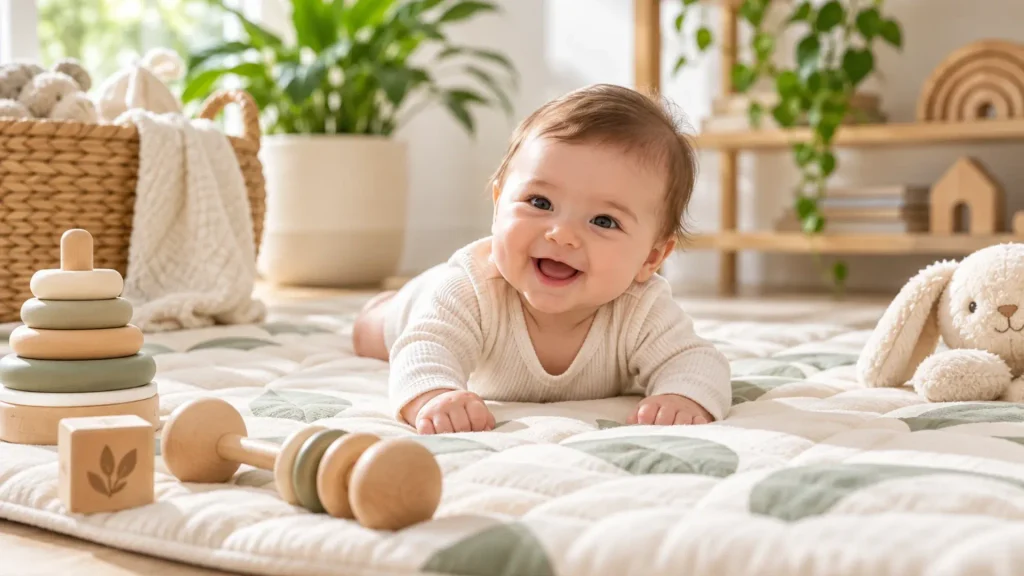
Little elbows, dribbly chins, and those first determined attempts to crawl deserve a comfortable place to land. For a non-toxic play mat, start with documented materials: an organic cotton cover, a clearly described core, and certifications that apply to those particular layers.
The Piccalio Play Mat is a practical choice for washable covers and a waterproof barrier. The Toki Bold Stripe Mat with Organic foam is the stronger fit if certified organic latex is your priority.
Here’s how each baby play mat compares before you make room on the floor.
At a glance
| Product | Best for | Key materials or certification | Main trade-off |
|---|---|---|---|
| Piccalio Play Mat | Washable, protected floor play | GOTS-certified organic cotton, natural latex, TPU waterproof barrier | Contains latex and a synthetic waterproof layer |
| Toki Bold Stripe Mat with Organic foam | An organic cotton-and-latex setup | GOTS-certified cotton cover and GOLS-certified Organic latex | The latex inserts need spot-cleaning |
Neither mat is a sleep surface. Keep both for awake, supervised play.
Piccalio Play Mat: best for washable floor play
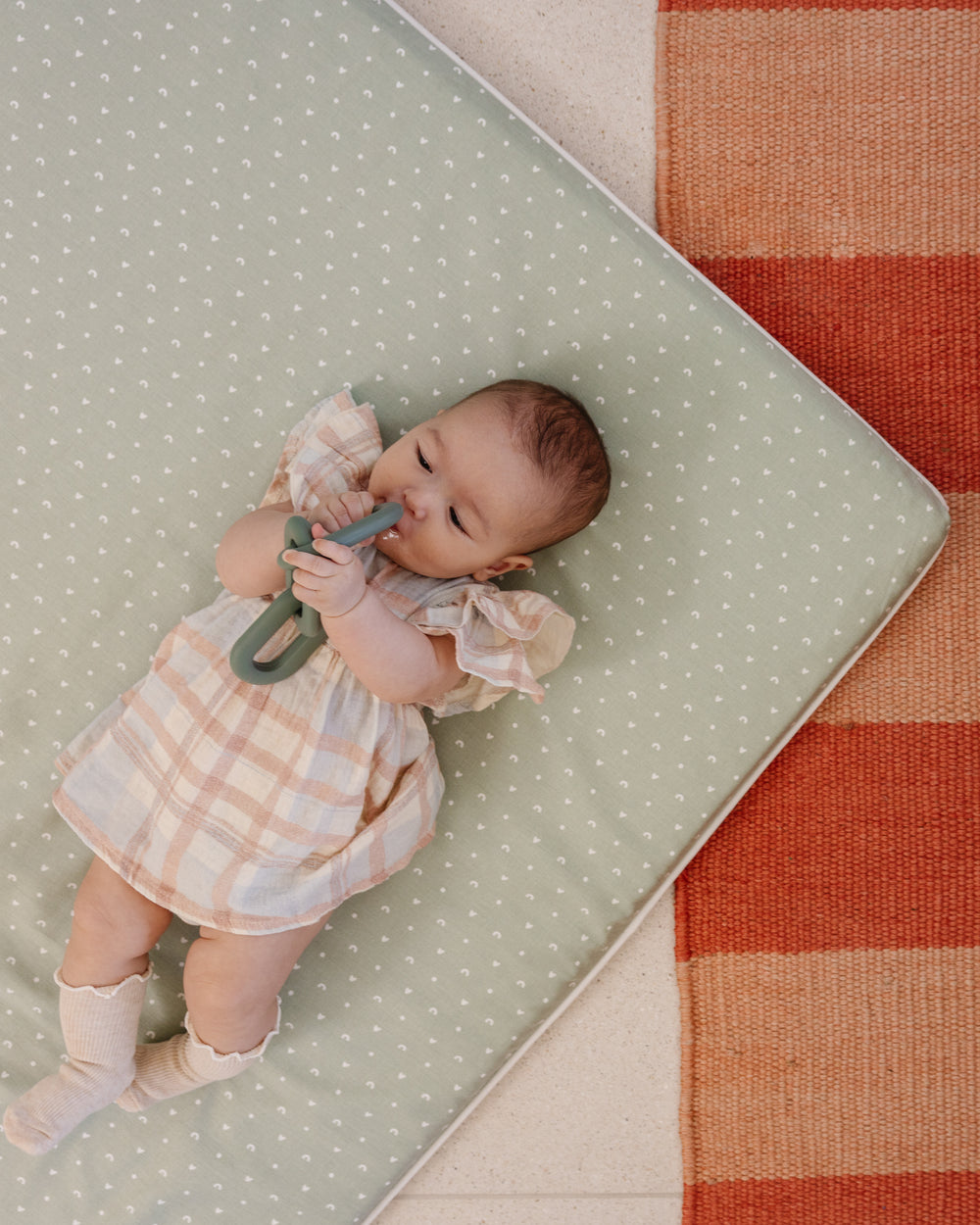
Choose Piccalio if you want a cotton surface against your baby’s skin without leaving the latex core exposed to every little spill. Its removable, washable covers make it a useful fit for everyday tummy time, especially when milk dribbles arrive before the laundry does.
Materials and cushioning
The Piccalio Play Mat measures 42 x 42 x 1.5 inches, approximately 107 x 107 x 3.8 cm. It combines natural latex foam with a 100% GOTS-certified organic cotton outer layer.
An inner waterproof cover contains cotton layers and a thermoplastic polyurethane, or TPU, barrier. That gives you a natural-fiber contact surface with a synthetic layer underneath.
Piccalio lists the mat as made without vinyl, phthalates, PFCs, polyurethane foam, EVA, and formamide. Those disclosures are useful because they describe more than the cover alone.
Who should choose it, and who should skip it?
Both the outer cover and inner waterproof cover are machine washable. Piccalio advises washing the outer cover before first use, a straightforward job to add to your first batch of baby laundry.
The square footprint works well for early floor play and rolling. It will cover less roaming space once your little explorer starts moving across the room.
Skip it if your household needs to avoid natural latex, or if you want a mat without a synthetic layer.
Europe availability: Available in Europe through Piccalio’s official store, which offers international shipping. Check delivery costs, duties, and availability at checkout.
Piccalio also lists ASTM F963 and U.S. CPSC standards among its compliance information. The CPSC’s toy safety guidance explains that framework; it isn’t an organic-material certification.
Toki Bold Stripe Mat: best for certified organic latex
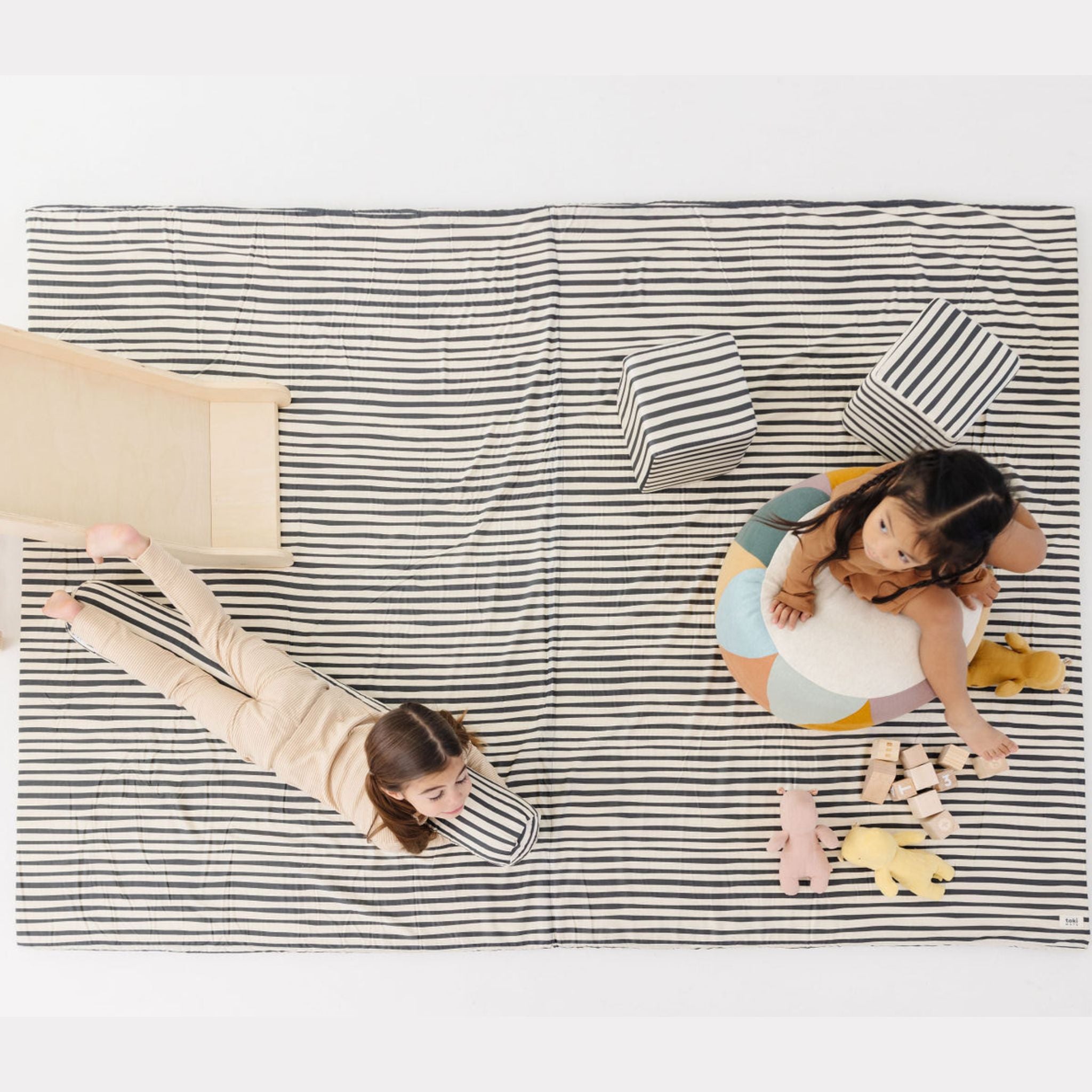
Choose the Toki Bold Stripe Mat with the Organic foam option if you want an organic cotton cover paired with certified organic latex. The configuration matters: Toki’s Classic and Organic foam options carry different certifications.
This is a premium choice, with a little more care involved than a wipe-clean surface.
What the Organic configuration contains
Toki uses two natural Dunlop latex inserts inside a removable cover. The inserts are 1 inch thick, approximately 2.5 cm.
Its organic cotton cover is GOTS certified. The Organic latex option is GOLS certified, while the Classic latex option is described as OEKO-TEX certified.
GOLS is the Global Organic Latex Standard. It covers organic latex production and processing, not every part of a mat.
Toki also says its latex foam isn’t treated with flame retardants. These are useful details for a cotton-and-latex setup.
Cleaning and everyday trade-offs
The cotton cover is machine washable, but remove the latex inserts first. Toki recommends a cold, gentle machine cycle with mild detergent; spot-clean the inserts instead. The whole mat isn’t machine washable.
That distinction matters after a leaky diaper or a generous spit-up. A washable cover simplifies cleanup, but the inserts need separate care.
Choose this version if certified organic latex is worth the premium price to you. Skip it if you need to avoid latex or want the quickest possible wipe-down routine.
Toki explicitly states that its mats aren’t intended for sleep.
Europe availability: Toki Kids’ official store ships to most international destinations; availability, import charges and shipping rates depend on the destination.
What matters in non-toxic baby play mats?
The phrase “non-toxic play mat” can sound simple, but the useful details are the cover, padding, waterproofing, and finishes, each described separately.
Foam, waterproof layers, and latex: what to check
For a baby play mat, we prefer to avoid EVA and PVC foam when material disclosures and independent testing are unclear. Some EVA foams may contain residual formamide, while PVC can contain added plasticizers. Look instead for a manufacturer that identifies the cover, filling, waterproof layers, and any relevant certifications or test results.
TPU is a synthetic material sometimes used as a thin waterproof barrier, not necessarily as the mat’s cushioning. Both Piccalio and Toki use natural latex foam, even though their cotton covers and foam options have different certifications. Neither is suitable when a latex-free mat is required. A quilted organic-cotton mat with documented non-latex filling can be a useful alternative. Check the complete product rather than assuming that an organic cotton cover means every layer is organic or latex-free.
How we chose and what certifications tell you
A certification is most useful when you understand what it covers. An organic cover, a substance-tested core, and an emissions-tested finished product answer different questions.
How we chose
Our priorities are documented organic textiles, clearly described padding, and practical care instructions. The two currently featured mats use organic cotton covers and natural latex cores. A third latex-free option is pending approval so that readers can also choose an appropriate non-latex material.
For these two models, compare certified organic latex with the convenience of a washable waterproof barrier. Families who must avoid latex should not select either model.
Read the scope, not only the badge
GOTS, the Global Organic Textile Standard, covers organic fiber content and textile processing requirements, including chemical restrictions and social criteria throughout the textile supply chain. A GOTS-certified cotton cover doesn’t automatically certify the mat’s foam or waterproof layer.
OEKO-TEX STANDARD 100 tests textiles for harmful substances. Product Class I covers babies and young children up to age three and has the strictest requirements. It doesn’t certify organic farming.
A useful certificate identifies the covered product or component, certificate holder, and validity period. A laboratory report identifies the tested sample, test methods, substances assessed, and results. Those details give a general testing statement its meaning.
Neither label means “chemical-free.”
Other good options
The Toki Bold Stripe Mat with Classic foam is an alternative if OEKO-TEX-certified natural latex meets your priorities; choose the Organic configuration when GOLS certification matters.
The Cream Haus Free Inward-Folding Play Mat measures 290 x 140 x 4 cm and offers a wipe-clean PE foam construction. It belongs to a different material category than the cotton-and-latex picks above.
Give crawling room, and keep cleanup manageable
The prettiest little cloth circle can feel generous during newborn tummy time. A few months later, your baby may roll straight off it.
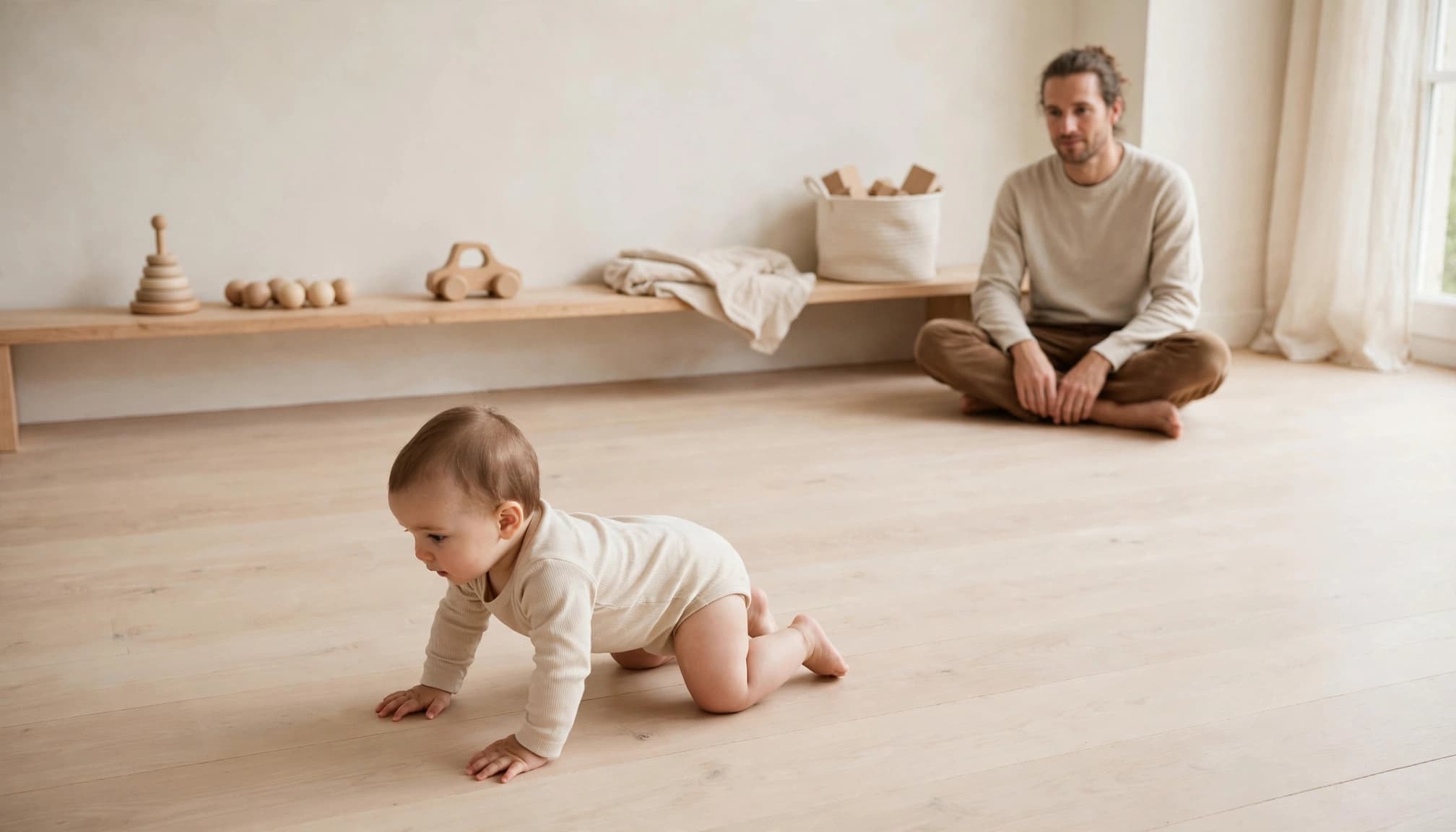
Size matters more as movement grows
For early tummy time, you need enough room for your baby’s body and an adult alongside. Once rolling begins, allow clear space beyond that starting position.
Crawling needs a larger floor area, with nearby furniture, cords, and small objects considered too. A mat cushions only the space it covers.
There isn’t one universal thickness that suits every baby and floor. Piccalio’s 1.5-inch padding and Toki’s 1-inch inserts are product specifications, not developmental requirements.
For crawling and pulling up, prioritize a stable surface that stays flat. Thickness alone doesn’t tell you how supportive a mat feels.
Make cleaning fit ordinary family life
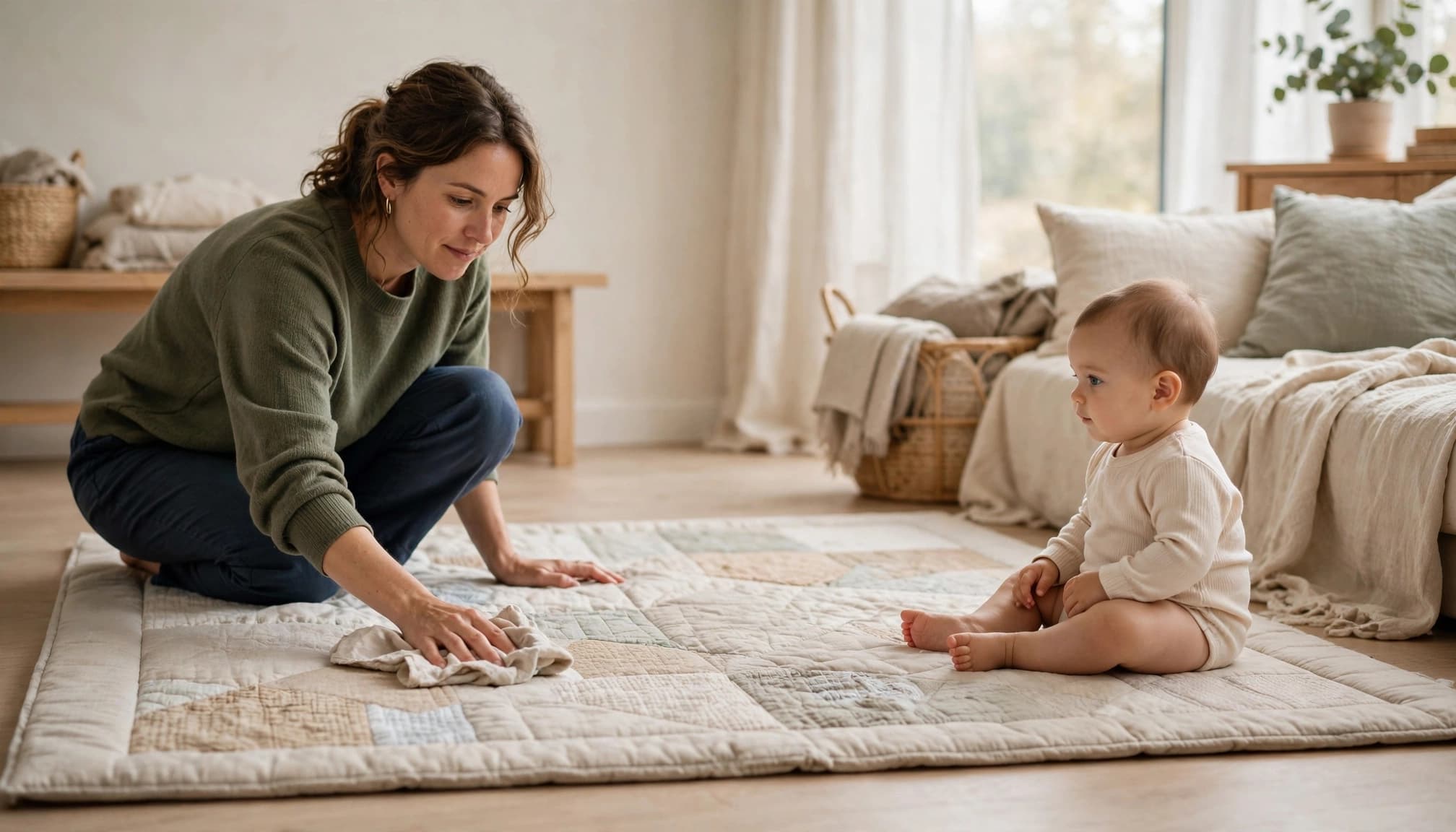
Remove spit-up and visible dirt promptly using the care method appropriate to the surface. Wash removable cotton covers as needed, and let every layer dry fully before reassembling.
A fixed weekly deep clean isn’t a substitute for cleaning the mess in front of you. Equally, you don’t need to disinfect the whole play area after every short session.
Keep latex inserts out of the washing machine. And avoid adding fragranced sprays or unapproved treatments to a surface your baby touches and mouths.
If floor play turns into a nap, move your baby to their own firm, flat crib or bassinet mattress, on their back, with a fitted sheet only.
Frequently asked questions
Does “non-toxic” mean a play mat contains no chemicals?
No. Every material contains chemicals, including cotton and natural latex. For shopping purposes, the useful information is documented composition, restricted-substance testing, and any relevant emissions certification. “Natural” and “hypoallergenic” don’t describe every layer or guarantee that a material suits a baby with an allergy.
How long does a new play mat off-gas?
There isn’t a reliable number of days that applies to every mat. Emissions depend on its materials, manufacturing, temperature, and ventilation. Odors may be more noticeable in a small enclosed room and can lessen after unpacking, but smell alone doesn’t measure exposure. Follow the manufacturer’s airing and care instructions.
Are foam puzzle tiles suitable if your baby mouths them?
Consider both material documentation and physical condition. Loose edge pieces, damaged tiles, or fragments can create a separate problem from chemical composition. Choose an age-appropriate product, supervise floor play, and remove damaged pieces. Check the complete material construction, including the filling; a cotton cover alone does not tell you whether the mat contains latex.
Choose the mat that fits your daily routine
Start with layer transparency, then choose that fits your household. Piccalio is the easier choice for washable, waterproof-protected floor play, while Toki’s Organic foam version makes sense if GOLS-certified natural latex is the priority. Both contain latex, so families who need to avoid it should select a clearly documented latex-free mat instead.
Choose a mat that stays flat, is easy to clean, and provides enough room for awake, supervised play. Never use a play mat as a substitute for an approved infant sleep surface.