
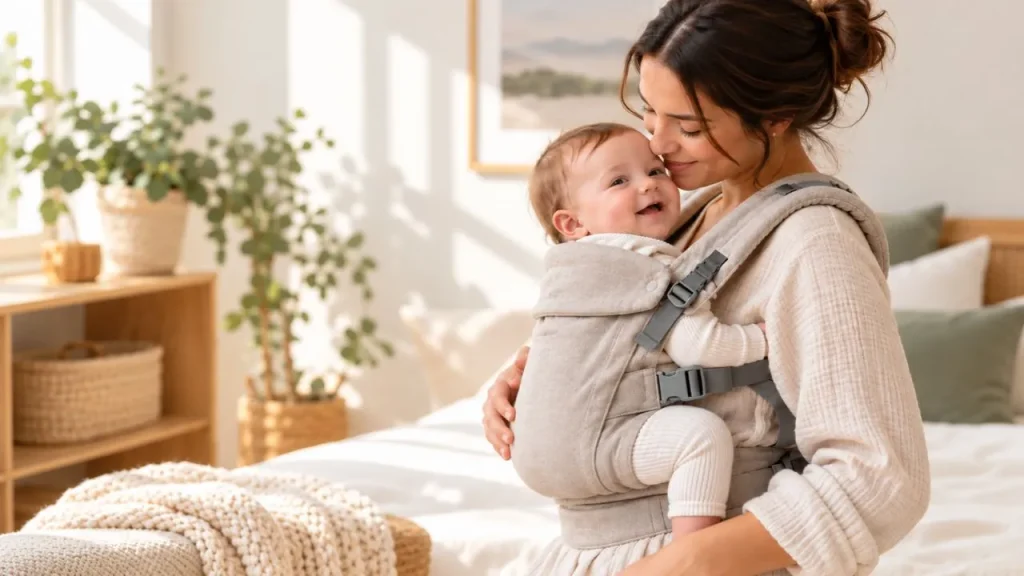
A practical babywearing guide starts with your baby’s size and development, then considers fit, fabric, and washing instructions. Soft cotton feels lovely against a little cheek, but fit and a clear airway come first.
Your comfort matters too, especially when a short walk becomes a long stretch of carrying. A carrier that needs delicate washing may feel less practical after another milky dribble.
Start with the stage your baby is in now, rather than buying for every possible future carry.
Key Takeaways
- Choose a carrier for your baby’s current size and development. Follow the exact model’s age, weight, and position instructions.
- Keep your baby’s face visible, chin clear of their chest, and airway unobstructed. Support the hips naturally without forcing the legs wider.
- Check certification for the specific carrier, and choose fabric texture and thickness that suit your comfort and climate.
- A carrier’s weight limit doesn’t guarantee a good fit. Check the panel against your baby’s body and stop using a carrier when it no longer fits well.
- Follow the care label, let the carrier dry fully, and inspect fabric, seams, straps, and fastenings before each carry.
A baby carrier guide by age and stage
Age gives you a starting point. Your baby’s weight, head control, ability to sit unassisted, and the carrier’s instructions complete the picture.
For younger babies, front inward-facing carrying is usually the starting position. Follow the exact model instructions before switching to another position.
Hip carries and back carries have different readiness requirements depending on the carrier. Follow its minimum age, developmental and positioning instructions; never use a position the model does not permit.
Framed hiking backpacks are not suitable for newborns. Wait until your baby can sit independently, has the necessary head and neck control, and meets the particular backpack’s age and size requirements.
For a premature or low-birth-weight newborn, or one with breathing concerns, speak with your pediatrician before babywearing.
Before the first outing, read the written instructions, weight limits, and labels, then practice fitting with a doll. In the US, the Consumer Product Safety Commission (CPSC) sets safety requirements for soft infant and toddler carriers; sling carriers have separate requirements. In Europe, EN 13209-2:2015 covers specified soft carriers with integrated leg openings. Always use the guidance for your particular carrier type and model.
Use these stages to narrow your options.
| Stage | Carrier types to consider | Position and readiness |
|---|---|---|
| Newborn to about 3 months | Model-approved wrap, ring sling, or soft-structured carrier | Front inward facing, within the model’s minimum weight and size limits |
| About 4 to 6 months | Suitable meh dai or structured carrier | Continue inward facing while head control and sitting develop |
| At least 6 months, sitting unassisted | Suitable meh dai, structured carrier, woven wrap, or sling | Hip or back carrying only when the model permits it |
| Toddler | Appropriately sized toddler carrier or woven wrap | Choose by body size and panel fit, not weight alone |
3 Carriers We Would Choose
These three carriers suit different babywearing needs: an adjustable buckle carrier, an easy-to-wear organic cotton wrap and a lightweight mesh option for the newborn months. We chose them for their clearly described materials, ergonomic features, practical fit and everyday usability. Before carrying, follow the exact model’s instructions for age, size, carrying position and fit.
1. Beco Gemini Organic: Best Overall Organic Baby Carrier
Why we would choose it: The Beco Gemini Organic combines an organic cotton outer fabric with an adjustable, hip-healthy seat, a padded waistband and multiple carrying positions. Its manufacturer lists a 7–35 lb range, although age, development and the manual still determine which positions are appropriate. We like it for caregivers who want a supportive, adjustable structured carrier rather than a wrap.

Best for: Caregivers seeking an organic cotton outer fabric and the convenience of adjustable buckles.
Keep in mind: We have not verified GOTS certification for the complete finished carrier; finished-carrier GOTS certification has not been confirmed.
2. Baby K’tan Organic: Best Wrap-Style Carrier
Why we would choose it: The Baby K’tan Organic is made with 100% GOTS-certified organic cotton fabric in a ready-to-wear, double-loop wrap-style design. There is no long length of fabric to tie each time. Its manufacturer lists an 8–35 lb range and hip-healthy carrying positions when the carrier is fitted and used correctly.

Best for: Parents who prefer the softness of an organic cotton wrap without traditional wrapping steps.
Keep in mind: The carrier is sized to the adult wearer. Choose the correct size using the manufacturer’s fit guide rather than buying based on the baby’s age.
3. BabyBjörn Mini 3D Mesh: Best for Newborns in Warm Weather
Why we would choose it: BabyBjörn Mini 3D Mesh is designed for a baby’s early months, with a soft, flexible mesh body, adjustable head support and front-release buckles. The 3D mesh is made of 100% polyester and is designed to let excess heat escape. Materials in contact with the baby meet OEKO-TEX STANDARD 100, Class I requirements. This is an OEKO-TEX-certified material choice, not an organic cotton carrier.

Best for: Newborns and caregivers who prefer a quick-to-fasten carrier in warmer weather.
Keep in mind: BabyBjörn recommends its Mini especially for approximately 0–6 months and up to 15 lb, even though the model is safety-tested to a higher weight. Mesh may feel cooler, but it does not eliminate overheating risk, so monitor your baby’s temperature and breathing.
Our Recommendation: Which Baby Carrier Should You Choose?
For an adjustable everyday carrier, we would start with Beco Gemini Organic. Its supportive buckle design and organic cotton outer fabric make it our best overall choice for caregivers who want an alternative to a wrap. The outer fabric is organic cotton, but GOTS certification for the complete finished carrier has not been confirmed.
For a soft wrap-style feel without learning to tie a traditional wrap, choose Baby K’tan Organic. Its GOTS-certified organic cotton fabric and ready-to-wear design are appealing for close, inward-facing carries. Check the adult wearer’s size carefully before ordering, since this carrier does not adjust like a buckle carrier.
For a newborn in warmer weather, consider BabyBjörn Mini 3D Mesh. The airy polyester mesh and easy-to-open buckles make it a convenient choice for shorter carries in the early months. It uses OEKO-TEX STANDARD 100 Class I certified materials, not organic cotton, and the mesh does not remove the need to monitor your baby’s temperature.
Our first choice is the carrier that fits your baby’s current size and your body comfortably. Before buying, check the manufacturer’s instructions for weight, carrying position and fit, and always keep your baby’s face visible and airway clear.
Choose fabric with clear certification
A baby carrier sits against your clothing, your baby’s skin, and sometimes a determined little mouth. Fabric deserves attention, but a natural-fiber name tells you only part of the story.
Understand what textile labels cover
For organic cotton, check whether GOTS certification applies to the fabric or to the entire finished carrier. The Global Organic Textile Standard covers organic fiber content and processing requirements, including chemical restrictions and social criteria.
Its “organic” label grade requires at least 95% certified organic fibers. The “made with organic materials” grade requires at least 70%.
OEKO-TEX STANDARD 100 tests products for harmful substances. Product Class I has requirements intended for babies and young children.
Certification should apply to the carrier you’re choosing, rather than another collection from the same brand.
Match texture and thickness to daily life
Cotton is a straightforward starting point if you want a familiar feel and manageable laundry. Linen can feel firmer initially, while a wrap may include elastane for stretch.
Construction matters alongside fiber content. Fabric and construction vary across a meh dai and other carrier styles. Multiple layers can feel warm, even when the fabric itself seems thin.
For warm weather, consider the complete setup: carrier layers, your clothing, your baby’s clothing, and the temperature. “Breathable” doesn’t mean overheating is impossible.
Choose a texture you find comfortable, with edges and seams that don’t rub. A certified fabric is useful; an elaborate fabric story isn’t something you need to pay extra for.
Get the fit right for both of you
A secure fit is part of safe babywearing every time you put the carrier on. A setting that worked yesterday may need adjusting over a thicker sweater or between caregivers.
Use a positioning check to protect breathing space
Raising Children Network recommends the TICKS positioning check:
- Tight: keep your baby close enough that they don’t slump inside loose fabric.
- In view at all times: see their face without moving fabric aside.
- Close enough to kiss: their head should be within easy kissing distance.
- Keep chin off the chest: leave space for unrestricted breathing.
- Supported back: support their natural position without letting them curl forward.
Keep your baby’s nose and mouth uncovered to protect their airway. Support their head without pushing it forward, and check their position as you move.
Remove your baby for feeding rather than feeding while moving in the carrier.
For a back carry, follow the carrier model’s instructions and check the fit before each use.
Support the hips without forcing the seat wider
Aim for a supported M position, with your baby’s knees slightly higher than their bottom and their thighs comfortably supported. The carrier should allow natural hip movement without forcing the legs wider than is comfortable or pressing behind the knees. Check that the seat adjusts to your baby’s size.
A restrictive legs-together position may affect hip development. Choose a seat that allows natural movement, and ask your clinician if you have concerns about hip dysplasia.
For you, the waistband should feel secure and the shoulder straps balanced. Walk around, bend your knees, and notice any pulling or pressure.
If your baby sinks or your shoulders ache, adjust the fit before assuming you need a different carrier. A qualified babywearing educator can help when positioning remains difficult.
Read each carrier’s range as model-specific guidance
A weight limit marks one boundary. It doesn’t tell you whether the carrier panel fits your baby today or whether you’ll find it comfortable at that weight.
A test weight isn’t a recommended use range
WildBird’s Aerial Buckle Wrap is intended for approximately 7 to 15 lb, though it’s tested up to 25 lb. That higher test figure doesn’t extend its recommended use range.
WildBird’s Aerial Buckle Carrier is a different soft-structured carrier, with a listed range of 7 to 45 lb.
Similar names make this distinction easy to miss. Read the instructions for the exact model instead of borrowing a range from another carrier in the collection.
The panel must fit, too
Hope & Plum lists its ring sling for 7 to 35 lb. Its Baby Lark is rated for 10 to 45 lb, and the brand says it fits best on babies wearing 3-to-6-month tops or larger.
A newborn may meet the sling’s minimum but still be too small for the Baby Lark.
The Kid Lark covers 25 to 65 lb and is intended for children solidly in size 3T tops or larger. The Kid Lark’s 25 lb minimum alone doesn’t establish a good fit.
If your child outgrows the Baby Lark panel before its maximum, choose an appropriately sized model. If a stretchy wrap becomes uncomfortable before its limit, you can move to another suitable carrier earlier. You don’t need to use every last pound of capacity.
Choose care you can manage on laundry day
A beautiful baby carrier still needs to cope with spit-up, damp straps, and everyday washing. Care instructions belong in your buying decision, especially if you won’t have a second carrier available.
Let the label set the washing routine
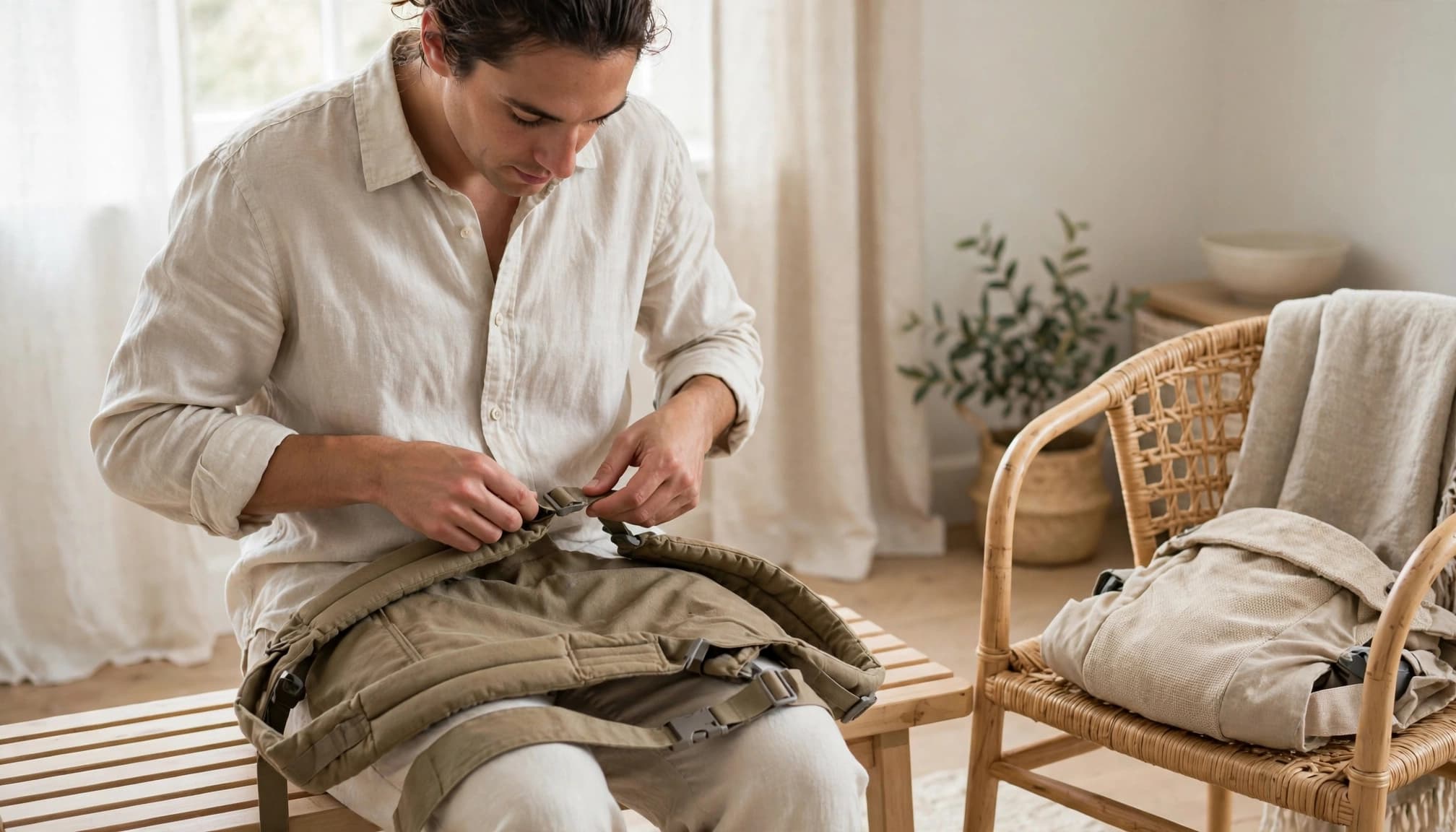
Follow the carrier’s specified washing and drying settings. Organic cotton, linen blends, padding, and hardware don’t all tolerate the same treatment.
Fragrance-free detergent is a practical choice if you prefer to avoid added scent. Fabric softener and scent beads aren’t needed to make a carrier comfortable.
Wash when soiled and according to the care label, rather than following an arbitrary weekly schedule. Consider drying time too: a heavily padded carrier may be less convenient when you need it again soon.
Inspect before the next carry
After laundering, look at the seams, fabric, straps, and fastening points. Make sure everything is fully dry and correctly reassembled before use.
Follow the manufacturer’s inspection instructions and stop using a carrier if you find damaged seams, fabric, straps or fastenings. The CPSC carrier guidance is another useful reference for US readers. Inspect secondhand carriers carefully, especially load-bearing stitching and buckles.
Frequently asked questions
How long can your baby stay in a carrier?
There’s no single time limit for every baby and carrier. When babywearing, follow the model’s instructions and take breaks for feeds, diaper changes, temperature checks, and movement.
Watch your baby rather than the clock alone. Fussiness, slumping, rubbing, or discomfort are reasons to pause and adjust or take them out.
What should you do if your baby falls asleep?
Move your baby to a firm, flat, noninclined crib or bassinet sleep surface as soon as possible, placing them on their back. Keep the sleep space clear except for a fitted sheet.
Until you can transfer them, stay awake and attentive, with their face visible and chin clear of their chest. A carrier isn’t a substitute for a recommended infant sleep space.
When can your baby face outward?
Use a conservative starting point of about 6 months, independent sitting, and steady head and neck control. The carrier must permit outward-facing use; some models require a later start.
Keep outward-facing periods short and return your baby inward when tired or overstimulated. Don’t improvise an outward-facing position in a wrap, and don’t let your baby sleep facing outward.
Choose for the baby you’re carrying now
The right baby carrier fits your baby’s current body, supports a clear airway, and feels manageable on your shoulders. Documented materials and practical washing instructions help you compare models that meet those needs.
Start by narrowing your options to your baby’s stage and size. Then compare certification, adjustability, and care.
You don’t need a carrier for every possibility. Choose one that fits well today and has instructions you can follow confidently.